It is believed that as early as the Paleolithic period, distinguished by the original development of stone tools over three million years ago, mankind has been inventing and improving.

The concept of inventing has always been regarded as a creative mental activity carried out by a human being. Fast forward to the 21st century, with the rapid development in AI in recent years, generative AI tools can now be used to create entirely new designs by themselves, as discussed in ‘Maurice Conti’s TEDTalk on The incredible inventions of intuitive AI. This raises the question, could an AI system be named as an inventor for a patent application?
In 2008, Dr Stephen Thaler began experimentation on a new type of artificial neural network called DABUS Device for the Autonomous Bootstrapping of Unified Sentience. By 2018, DABUS reportedly conceived two inventions. Dr Thaler filed patent applications for the inventions naming DABUS as the sole inventor, and the Artificial Inventor Project was born. Patent applications were filed in the major jurisdictions around the world including the UK, Europe, US and Australia causing the respective patent offices to form a view about who can be an inventor.
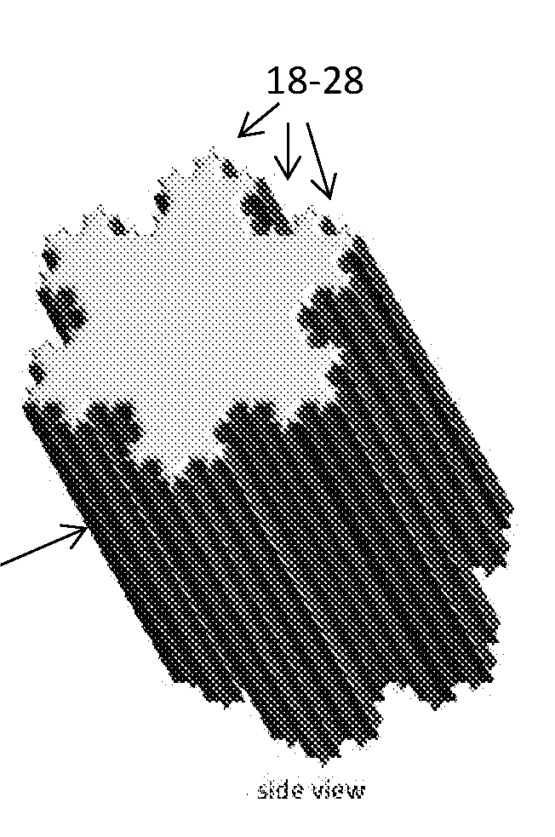
One of the inventions described in the patent applications, (including Australian application no. 2019363177, is directed to a food or beverage container with a wall profile having pits and bulges as shown in some of the specification drawings reproduced below. The unique profile enables multiple containers to be releasably coupled together without separate fasteners. The increased surface area is also believed to facilitate heat transfer and grip.
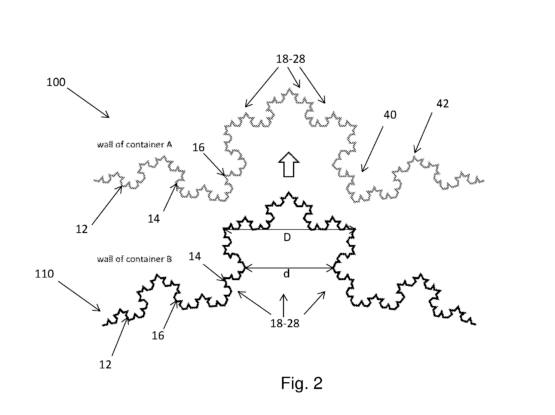
In February 2021, IP Australia issued its decision in Stephen L. Thaler [2021] APO 5 addressing the inventorship question. It determined that a patent can only be granted to a person. An AI machine is not a person, and it is not possible for a person to derive title to an invention devised by a machine from the machine as the law does not presently recognise the capacity of an artificial intelligence machine to assign property.
The Delegate also considered that since Dr Thaler asserted that he did not devise the invention, but merely acquired knowledge of the invention from the AI machine, Dr Thaler would not be the inventor.
Finally, the Delegate concluded that the law as it currently stands in Australia is inconsistent with an AI machine being treated as an inventor. In this case, since it was not possible to identify a person who can be granted a patent, the application failed to meet filing formalities. As this deficiency was not capable of being corrected, the application lapsed.
Accordingly, it appears that a patent application naming an AI machine as an inventor cannot be validly filed in Australia, principally because there is currently no mechanism for a nominated person to derive title to the invention.
While specific legislation regarding inventorship varies in different jurisdictions, related overseas applications naming DABUS as the inventor have received similar outcomes.
In January 2020, the European Patent Office refused two patent applications on the grounds that the applications listed the AI machine DABUS as the inventor and not a ‘natural person’, and that designating a machine inventor with a name does not satisfy the requirements of the European Patent Convention. Similarly, in July 2020, the UK High Court upheld a 2019 UK Intellectual Property Office decision stating that an inventor can only be a ‘natural person’, and not a machine. The UK High Court and EPO each found that an AI machine could hold no rights, and could not transfer any rights to an applicant as successor in title.
In February 2020, the US Patent and Trademarks Office issued a decision denying a petition to vacate a Notice to File Missing Parts. The Notice indicated that the application did not ‘identify each inventor by his or her legal name.’ The USPTO rejected the notion that an inventor could be construed to cover machines, referring to dictionary definitions and case law indicating that an inventor must be a natural person, and that the inventor who executes an oath or declaration must be a “person.”
Dr Thaler has appealed the decisions in the UK and EPO, and now has the right to appeal to the Federal Court of Australia.
So, what do an AI machine like DABUS and a monkey have in common? In the monkey selfie copyright dispute, it was found that the monkey was unable to hold copyright in a selfie picture because it was a non-human creator. Just like that monkey, DABUS is unable to be named as an inventor because it is not a natural person.
It seems that without legislative reform, it will be difficult to obtain patent protection for an invention devised solely by an AI machine. It has been argued that this is not necessarily a bad outcome, as allowing patent applications to be filed for inventions generated by AI machines may stifle rather than promote innovation. In any event, the question of inventorship may not be the only hurdle to protection for AI devised inventions. Of course, there is also the question of whether an invention devised by an AI machine during normal operation e.g. executing an iterative process to determine optimum design features of a product would be obvious. Perhaps this will be the next question.